Tuesday, June 26, 2007

ADVENTURES IN TAKASHIMAYA

I had a yen to go to Takashimaya, a Japanese department store on 5th Avenue and 55th Street in Manhattan. There's a calm, peaceful feeling in that place. The merchandise is minimal, so there's plenty of room to walk around. What I noticed right away during this visit is that the gorgeous flower section had dissapeared from the first floor. What?!?! The flowers had been the main draw on that floor. The store, after all, is known for their stunning flower arrangements. I kept exploring the different floors and discovered that the flowers had been moved. Where before the flowers had been positioned near the front window on the first floor, they were now in the back of the 6th floor and esconced in low lighting. There was a long velvet couch where one could recline to read gardening books and to take in the quiet and the flowers. I felt like I was in a rainforest that happened to have a lounge.

I took at look at garden-related items on the shelves and found these incredible hand made cards (including the birdy one picured above) from a company called Pixie Designs. Lisa Kovarik heads up this company, and her creations can be found at www.pixiecards.com On the back of each card, it says "Pixie Designs celebrates the marraige of exquisite papers - notably silkscreened Japanese chiyogami - and the art of collage. Multiple pieces and patterns blend beautifully to create original artwork that is reproduced , then finished by hand."

While at Taka, I also ventured down to the basement tea room. With very little visual stimuli, the room is a welcome relief in contrast to the visual and auditory intensity of the rest of New York City. I decided to get earl grey ice cream, something I've never tried before, and matcha iced tea. The tea is bright green, so it looks like wheatgrass juice.

Going back to the floor switcharoo: I was a little bummed about the fact that the first floor was now filled with makeup and makeup counters. This feature makes it like a lot of other 5th Ave. department stores designed to draw in women, and, I'm guessing, more revenue. The flowers, on the other hand, drew in both men and women and were about natural beauty rather than artificial beauty.

Still, Takashimaya remains a haven and an oasis for me.

PS - A great gift item, located on the floor with bedding, are the soaps from Fresh. Each soap is hand-wrapped with thick patterned paper and tied with a tiny stone on top. Even though I don't generally like perfumed products, I think these smell great.

Sunday, June 10, 2007

THE 2nd ANNUAL WRITE-A-THON

Yesterday, with the support of nineteen friends, I participated in the 2nd Annual New York Writers Coalition Write-a-Thon. The purpose of the event was to raise money for the good work of the Coalition. Led by Aaron Zimmerman, the staff annually conducts 550 free writing workshops for the unheard populations in NYC, including at-risk youth and older adults. The Coalition also publishes anthologies of the writings that emerge from these workshops and creates forums for the participants to read their creations in front of audiences. Good stuff.

With $600 in pledges (thank you, sponsors!), I subwayed to The Small Press Center on West 44th Street in Manhattan. Shortly after arriving, I attended a writing workshop led by one of the Coalition Staff. She showed us a bunch of slides that served as visual prompts and then we got to write for 20 minutes based on one or more of those prompts. So I wrote what became Thoughts about Death. Each person in the workshop got to read his or her piece out loud and the other members of the group got to say what they liked or remembered about the piece.
I was blown away by the writing of a teenager in that workshop. A ninth-grader, she was the youngest person at the Write-a-Thon. After the workshop was over, I went back to the main room and sat at a table with her. She showed me more of her writing and I talked a little bit about my blog. We were then joined by another high-schooler and also by a woman who wants to write more but does not have a computer at home.

The four of us had lunch together and then a guy named Chris Baty gave the whole entire Write-a-Thon a pep talk about aiming for quantity and quality in writing as a way of getting both. Chris started this wild thing called National Novel Writing Month (NaNoWriMo) where participants begin writing November 1 with the goal of writing a 175-page (50,000 word) novel by midnight, November 30th. "The kamikaze approach forces you to lower your expectations, take risks, and write on the fly. Make no mistake: You will be writing a lot of crap. And that's a good thing. By forcing yourself to write so intensely, you are giving yourself permission to make mistakes. To forgo the endless tweaking and editing nd just create. To build without tearing down."
The highlight of the Thon was participating in the morning workshop, being around other writers, and making friends with young writers.

If you would like to make a contribution to the work of the Coalition, it is not too late! You can visit my sponsor page here, where donations will be accepted through August 11th.

SOME THOUGHTS ABOUT DEATH

Is it really honoring the dead to bury them in a graveyard and put a gravestone on top of where they lay? Why are many of us creeped out by graveyards? Why are graveyards included in so many scary movies? Are we saying that death is inherently creepy?

These questions make me think that graveyards (a) shouldn't be called graveyards and (b) could look and feel differently than they do now.

When Jim Henson, creator of the Muppets, died, they held a service for him in the majestic Cathedral of Saint John the Divine. Some of the Muppets spoke and sang at the service. They played the theme song to Sesame Street. There were lots of bright colors. None of this was a denial of the sadness that Jim's death brought on. It was a reflection of his request to have a ceremony that celebrated the spirit of his life.

I'm not saying that everyone has to have the theme song of Sesame Street played when they die. That wouldn't be right for a lot of people. For example, my mom said that she wants us to play the YMCA song at her funeral. Being the midwestern innocent that my mom is, she doesn't know what that song is really about. Doesn't matter, though. What matters is that when my mom hears YMCA at a wedding or in aerobics class, she waves her hard-working midwestern hands in the air, gets that shiny look in her eyes, jumps up and down, and smiles like a Cheshire cat. YMCA gets her grooving extra hard on life.

But back to my main point: death and what we do with the dead doesn't have to be so damn creepy and morose.

Instead of having graveyards, we could have gardens where the loved ones of the dead go to sit, drink iced tea, plant things, read, swing in hammocks, etc. I know I would be a lot more motivated to visit my deceased relatives out in Queens if they were buried in a place like that.

Another idea: people could request to have memorial plaques put up in their own personal favorite places, like the neighborhood park bench, the beach they went to on the weekend, the diner they frequented late at night, the toy store they went to with their children.

My point is, let's think freshly about the aesthetics of how we honor the dead.
---------------------------

Post Script:
Places I Might Want to Hang a Memorial Plaque if I Passed Away

1. Dashing Diva Nail Salon on Smith Street in Cobble Hill, Brooklyn
2. The children's section of the video rental store
3. Housing Works Used Book Cafe in Soho
4. The sculpture garden at MOMA
5. Donnell Library
6. A window table at the cool, cavernous Sarabeth's restaurant in the basement of the Whitney Museum
7. The balcony at my cousin's apartment
8. The pen section of Staples Office Supply store
9. The greeting card section of Eckert Drugstore
10. The roof of the Metropolitan Museum of Art

Friday, June 01, 2007

JUNE BIRTHDAYS

  1. Morgan Freeman, actor
  2. Cornell West, scholar and writer
  3. Josephine Baker, dancer and actress
  4. Bruce Dern, actor
  5. Bill Moyers, TV journalist
  6. Deigo Velazquez, artist
  7. Prince, singer and songwriter
  8. Frank Lloyd Wright, architect
  9. Johnny Depp, actor
  10. Maurice Sendak, children's book author and illustrator
  11. Jacques-Yves Cousteau, oceanographer
  12. Ann Frank, diarist
  13. Ally Sheedy, actress
  14. Margaret Bourke-White, photographer
  15. Helen Hunt, actor
  16. Stan Laurel, comic actor
  17. Dan Jansen, Olympic speed skater
  18. Isabella Rossellini, actor
  19. Kathleen Turner, actor
  20. Danny Aiello, actor
  21. Juliette Lewis, actor
  22. Bill Blass, fashion designer
  23. Wilma Rudolph, Olympic runner
  24. Michele Lee, actor
  25. Carly Simon, singer and songwriter
  26. Pearl S. Buck, writer
  27. Helen Keller, radical educator and writer
  28. John Cusak, actor
  29. Claude Montana, fashion desiginer,
  30. Lena Horne, actress and Singer

    -- taken from The Astrology Book of Days: An Illustrated Perpetual Calendar and from famousbirthdays.com

MORE FROM FREE PLAY

"We often make the mistake of confusing education with training, when in fact these are very different activities. Training is for the purpose of passing on specific information necessary to perform a specialized activity. Education is the building of a person. So educe means to draw out or evoke that which is latent; education then means drawing out the person's latent capacities for understanding and living, not stuffing a (passive) person full of preconceived knowledge. Education must tap into the close relationship between play and exploration; there must be permission to explore and express. There must be validation of the exploratory spirit, which by definition takes us out of the tried, the tested, and the homogeneous."

-- Stephen Nachmanovitch, Free Play: Improvisation in Life and Art

Tuesday, May 29, 2007

FREE PLAY

Free Play:Improvisation in Life and Art is a nifty and profound book which I picked up from Friends of The Library. First of all, if you are a New Yorker, you must go to Friends of the Library! It is located in the basement of the Webster branch of the NYPL. Super friendly folk sell gently used books for rock bottom prices. All the money goes to support the library. Need I say more?

Free Play, written by Stephen Nachmanovitch, is full of inspiring passages. Here is one of them:

"Every moment is precious, precisely because it us ephemeral and cannot be duplciated, retrieved, or captured. We think of precious things as those to be hoarded or preserved. In the performing arts we want to record the beautiful, unexpected performance, we schedule a rematch for the camera. Indeed, many great perfomances have been recorded, and we are glad to have them. But I think the greatest perfomances alway always elude the camera, the tape recorder, the pen. They happen in the middle of the night when the musician plays for one special friend under the moonlight, thay happen in the dress rehearsal just before the play opens. The fact that improvisation vanishes makes us appreciative that every moment of life is unique - a kiss, a sunset, a dance, a joke. None will ever recur in quite the same way. Each happens only once in the history of the universe."

Sunday, May 20, 2007

LISTEN (TO) MISSY

I had been reading Missy's blog, Listen, Missy!, for a year before I got up the courage to ask her to interview for Creative Times. When I sat down to meet Missy in person, I was immediately struck by her open, friendly voice and face and total lack of pretense. She freely shared info about her history in the manner of a small townperson who had invited me up on her porch for a cup of lemonade. The other great thing about Missy is that she is chock-full of raw talent yet is totally unassuming about it. She is a skilled and accomplished photographer, dancer, and sewer.

Missy's blog started as a website in the summer of 2000. She was living in DC and training for a marathon as a strategy to kick the habit of smoking. Missy laughed as she remembered using the website to vent about the physical pain she was in while training.

Missy recalls finding the first wave of blogs. "[They] were essentially being written by tech-savvy folks, programmers and the like, and by music fans, mainly of the indie rock crowd who grew up with the 'zine format," she explained. Inspired by this new vehicle for sharing information, Missy decided to abandon the website and make the transition to blogging. "At first, the blog was about me being bored at work," she explained. "Over time, I developed voice and purpose. The blog was a great way to share what I was up to with people I knew."

Missy takes pride in the fact that she alludes to different forms of creativity in her blog without using a "reporting stance." She focuses on sharing personal experiences about what excites her and interests her- namely, art exhibits and dance performances.

Given her humble and friendly demeanor, it came as no suprise to learn that Missy has roots in the midwest. There, she was a member of 4H and grew up knowing a grandma who was a seamstress and a piano player. Missy has memories of visiting her grandmother's farm, where she'd climb up into a tree and tell stories into a tape recorder.

What does Missy see when she looks into the future of her blog? "My blog serves as a scrapbook of the things I've done and the places I've been," she shares. "I plan to go with the flow."

Sunday, April 29, 2007

A CHEROKEE FEAST OF DAYS

One Friday afternoon during my lunch hour, I stumbled upon The National Museum of the American Indian. After having a chat with the friendly man behind the information desk, I strolled into the gift shop. (I'm a sucker for museum cafes and museum gift shops.) I found this great little book, A Cherokee Feast of Days, by Joyce Sequichie Hifler. Ms. Hifler is a descendant of the Sequichie family, which immigrated to Oklahoma over the Trail of Tears.

The book features a one-paged entry for each year, and each of those entries highlights a piece of wisdom from Native philosophy. Each morning, after waking, I read the entry for the day.

Here's an entry I like from April 24:

The wild pink verbena that grew so profusely along the slopes have moved to another area. In their place are yellow flowers, unfamiliar but like sunshine after a shower. A familiar saying is that the more something changes, the more that it stays the same. Flowers, like people and circumstances, change so swiftly and unexpectedly that it seems like the very foundation of the familiar is moving and changing before us. The Cherokee call this "a ma yi," creek water. It is always moving and changing before our eyes. Nature reminds us to renew our minds -- to update and enlarge our vision instead of accepting the daily changes of the world that come to nothing. No one has ever been so perfect that she cannot surpass herself and bloom more brilliantly in another area.

Monday, April 09, 2007

GODS' BARBERSHOP

The L Magazine is a little publication you can get for free in New York, along with The Village Voice, The New York Press, and The Learning Annex Catalogue. The L, like these other pubs, has some seedy components to it, but I always peek to at least see what's on the cover.

Well, this last issue was called "The New Yorker's Guide to God" and the cover was the best I've seen yet. If you look closely, you can see that Jesus is getting his hair cut and so is Buddha.

I looked inside the issue and discovered that the painting featured on the cover, called God's Barbershop, was done by an artist named Yunmee Kyong.

I found the official website of Yunmee plus the website of the folks who rep her (make sure you click on the thumbnails) and discovered that she was born in Korea and is a prolific illustrator. Matter of fact, Ms. K won the 2006 Ezra Jack Keats Award for her illustration of the children's picture book Silly Chicken. Yunmee's work reminds me a lot of Maira Kalman's work in terms of its whimsical quality and color palette. At the same time, there is a deepness to it and a spiritual quality. It's spiritual without being too flourishy or somber. Nice balance there.

I sent Ms. K an email saying that I love barbershops and beauty salons and could I meet up with her to interview her for Creative Times. She wrote back right away, saying that she would love to meet except that she is in France right now doing a residency program that is connected to the Gods' Barbershop painting. She offered to email a little bit about what she's doing and I said "Yes!" and this is what she said:

Hi Eleanor: Yes, me too- I always am interested in barbershops and hair salons, and want to draw while I'm in them. I want to do series of drawings as well: I am working on a project of different gods, people of different religions, cultures being together, or doing things together.

The painting you saw is part of my project. When I visted Oaxaca, Mexico last October, I saw some barber shops I liked and took pictures and after I got back I put all the pcitures from Oaxaca around me and started the painting. I want to do installatons of different gods, people as well. Last year at AG gallery,I did an installation of Buddha, and Ganesha having a tea party and invited people to sit together as well.

Warm Springy Day,
Yunmee

Saturday, April 07, 2007

THE LIBRARIAN AND THE GARDENER

Amy Martin is the librarian at Public School 116 in Manhattan. Stanley Kunitz was a prolific poet and gardener who passed away last year at age 100. Recently, I interviewed Amy for Creative Times. Shortly afterward, I read Kunitz’ The Wild Braid: a poet reflects on a century in the garden. And then something interesting happened: whenever I thought of Amy, I thought of Stanley. They always appeared in my mind as a pair.

There are some striking similarities between running a library and overseeing a garden. Maybe that’s why I think of Amy and Stanley simultaneously. The Wild Braid features photographs of the author in his lush, magnificent garden. It’s the place where Stanley connects to nature, ideas, creativity, to a deeper level of thinking. In the photos, Stanley looks completely at peace.

Like Stanley, Amy has created an oasis of calm which belies a fertile ground for sowing the seeds of wonder, imagination and reflection. A gardener in her own right, Amy is always planting and weeding books in order to set the stage for curiosity and connection-making. Upon entering the sun-soaked room, the visitor sees the results of her careful tending: each carefully-picked book perches upright on a shelf or in a tabletop basket for easy perusal and enjoyment.

When I asked Amy for a bit of advice for aspiring librarians out there, she made this recommendation:

Have a sense of wonder and nurture that sense of wonder in children though books, conversations, and questions. Be prepared to be surprised yourself by what they want to learn; don’t be judgmental.

Amy’s pearl of wisdom reminded me of this excerpt from Kunitz’ Wild Braid:

This is one of my principles in teaching as well [as in gardening]. It’s a terrible mistake to impose your pattern on a student. Something that especially pleases me about my students is that they’re all so different, each one. What one needs to cultivate in a young poet is the assertion of that particular spirit, that particular set of memories, that personhood.

In their words and in their actions, both Stanley and Amy have provided something necessary in our fast-paced world -- a physical and mental space where people can let their minds roam and connect to the idea or feeling they need at the moment. Maybe that’s why Cicero said “If you have a garden and a library, you have everything you need.”

Monday, February 19, 2007

KEITH HARING LIVES ON

I spy with my little eye some Keith Haring stuffed animal dogs in the window of a children's store on Elizabeth Street. I was so happy to see these dogs and realized that I still miss having Keith Haring's Pop Shop around. Keith opened the SoHo boutique in 1985 as a way of making his work available to the public. The shop closed its doors in 2005.

HELLO KITTY HONGBAO

One Chinese New Year tradition involves the giving of Hongbao. Hongbao are red packets with money in it, which symbolizes luck and wealth. Red packets are typically handed out to younger generation by their parents, grand parents, relatives, close neighbors and friends.

In Chinatown, you can find shops and sidewalk vendors selling lots of different kinds of Hongbao. A fan of Hello Kitty, I picked up the Hongbao shown to the left.

Happy New Year!

GUNG HAY FAT CHOY!

The Chinese New Year began yesterday, February 18th. Because my San Francisco elementary school celebrated the Chinese New Year on our playground, this occasion has special meaning to me. I remember watching The Dragon Dance and The Lion Dance in awe.

Here in New York, I am blessed to live near Chinatown. Chinatown brings my senses alive. During the months leading up to the New Year, the shops - may of them open-air - are filled with special decorations and Hongbo, red envelopes that adults fill with money and give to young people for luck. The gentlman above is selling Hongbo to sidewalk passersby. I indulged in Snoopy- and Hello Kitty-themed envelopes.

The Chinese New Year is the first day of the lunar calendar, so it is also called Lunar New Year or Spring Festival. Records whow that the Chinese started to celebrate the New Year about 2000 BC, on the first day of the lunar calendar based on Emporer Wu Di's almanac of the Han Dynasty.

Chinese New Year celebrations include the following traditions:

1. One month prior to the Chinese New Year, participants clean and decorate their homes, buy new clothing, get haircuts, prepare food to last two weeks.

2. A New Year's Eve dinner.

3. Firecrckers, which signal getting rid of the old and welcoming in the new.

4. Hongbao - red packets filled with money to symbolize luck.

5. The Dragon and Lion Dances.

6. The Lantern Festival.

Sunday, February 04, 2007

WHAT IZ A DREAM BINDER?

In years past, I've made Dream Collages or Treasure Maps. That's where you cut out magazine pictures which represent the things you want to bring into your life. You glue the pics down onto a large piece of posterboard and put the board in a place where you look often, like over your desk. The last couple of Dream Collages I made kept falling off the wall and took up a lot of space in my petite home office. Furthermore, they became like wallpaper - something I looked at so often that it faded into the background.

Last year, I decided to do something different; that something evolved into a Dream Binder. It's a 3-ring binder and in it I keep documents and mementos related to my goals for the year. I mostly use mag. photos or write notes on 3x5 cards to record what I want or what events occured that related to my dreams. OR I write something I want as if it has already occurred.

Quick Dream Binder tip: I use thin black paper covered by a thin plastic protector and designed for a 3-ring binder. This product makes it easy to slip in or glue down 3X5 cards or paper mementos.

Here's something interesting that happened in my dream binder last year: I cut out pictures of two things I wanted to win in the New York Public Library Sweepstakes. Although I did not win the spa vacation, I did win a gift certificate to a restaurant in Manhattan! In looking in Dream Binder 2006, I also see seeds of good things that have started to happen this year.

In summary, a Dream Binder is both a scrapbook and a crystal ball. You can look into it to see good things that happen along the way and to set your intentions for good things to come.

Try it! You'll like it!

( PS - The above photo of America Ferrera in her role of Betty Suarez in Ugly Betty is the cover of this year's Dream Binder. )

Sunday, January 28, 2007

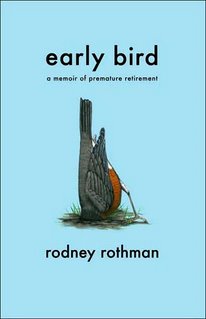
RODNEY ROTHMAN'S EARLY BIRD

What happens when a 28-year-old spends half a year living in a retirement community in Florida? Read Rodney Rothman’s Early Bird: a Memoir of Premature Retirement to find out! Last summer, when I was in a neighborhood bookstore, the cover of Early Bird caught my eye so I picked up a copy off a table and started reading different passages. Laughing out loud upon contact with the print meant this book was worth buying.
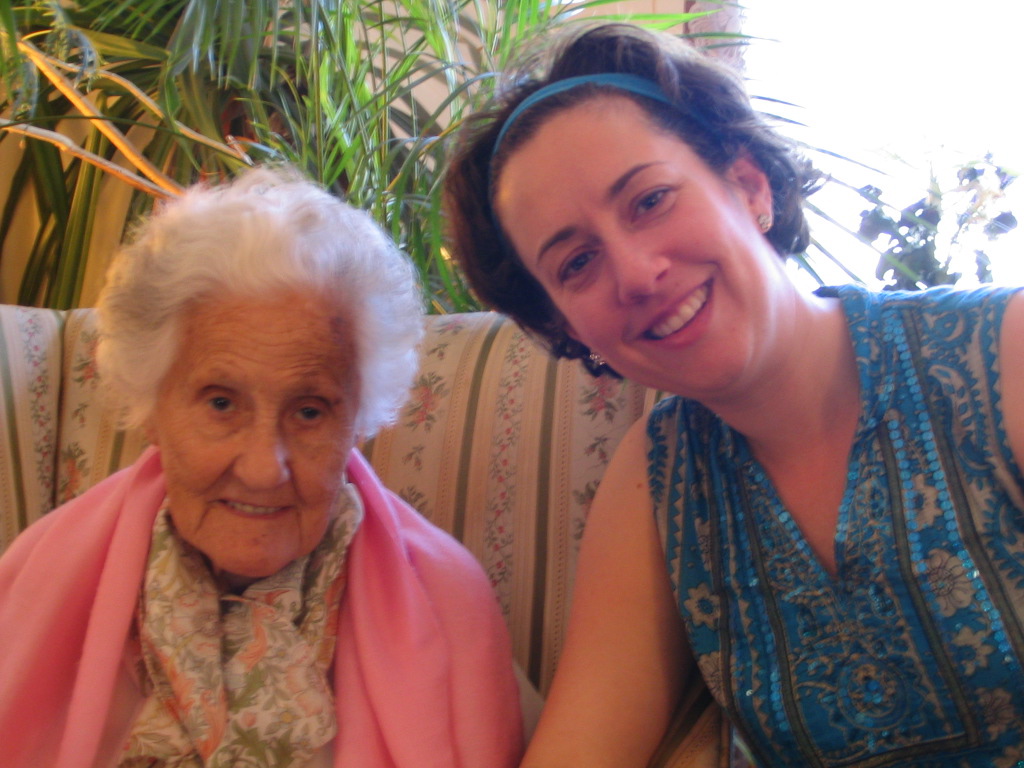
A former writer for The David Letterman Show, Rodney has a penchant for using humor, but never in a way that denigrates older adults. Through narrative, he describes his interactions with the retirees and their interactions with one another. He intersperses the stories with his research about the history and demographics of aging and the elderly in this country. The research is useful, because it provides a context for his anecdotes.

What appealed to me about this book? Why am I promoting it? As someone who prizes my relationships with older adults and treasures their wit and wisdom, I was encouraged to see that someone from my generation had slowed down enough to observe and record what it’s like to be an older adult this country. Because Rodney spent a full half year at Century Village and developed relationships with people there, he was able to document, in a meaningful way, both the strengths and the struggles of this population.

There’s something about the time Rodney took each day to talk with, observe, and interact with the elders that contradicts our normal inclination to rush through each day, to associate mostly with people from the same age or background, and to be as “productive” as possible. In this country, there is a huge emphasis on efficiency, productivity, and economic and geographic mobility. Within that emphasis, the possibilities for intergenerational connections are often lost. Elders and their life experiences are often pushed aside; they are segregated into communities where their contact with younger people is limited and vice versa. Aren’t our lives the richer for our relationships across lines of age? My own experiences and Rodney’s book tell me “Yes”.

Saturday, January 13, 2007

MEETING EVA ZEISEL

I first learned about Eva Zeisel during a June 2006 episode of CBS News Sunday Morning. She was born in 1906 to a Jewish family in Hungary, and, over the course of her life, has designed roughly 100,000 glass and ceramic objects. As a young adult, she was made Director of Glass and China for the USSR. A year later, she was arrested and imprisoned for 16 months in Moscow on suspicion of plotting to assassinate Stalin (!). Twelve of those months she spent in solitary confinement. She was released for reasons unknown to her.

Shortly after her release from prison, Eva and her husband Hans came to New York with $64. She established the first American course teaching ceramics as industrial design at Pratt University. She also opened a design studio in the basement of her apartment building on Riverside Drive. In 1963, she created her last design for 20 years. After resuming activity in 1983, she designed metal dishes, crystal vases, lamps, office interiors, tea sets and martini glasses. She was the first person to design an all-white Modernist dinner service in the United States.

Five months after viewing Eva on television, I learned through newspaper articles and a Crate and Barrel ad that she was about to turn 100. I also saw that we shared the same birthday! That’s when I decided to pursue an in-person interview with her. My hands were shaking as I dialed Eva Zeisel’s telephone number. I was, after all, calling one of the biggest influences on 20th Century design who had just turned 100 years told.

“Who are you?” Eva asked in her Eastern European accent.

“Eleanor Traubman,” Ms. Zeisel. “I write a publication called Creative Times. I used to live in your neighborhood and I went to Bank Street [a grad school near her home]. We have the same birthday.”

Sweat was now running down my back as I stumbled to communicate the purpose of my call. “Ms. Zeisel, I would love an opportunity to interview you for my newsletter.”

I guess the spirit behind my call, certainly not my eloquence, came through because Ms. Zeisel eventually put her assistant on the phone with me. A few minutes later, I had successfully set up a time to visit with Eva in her home.

Shortly after I’d celebrated my 37th birthday and Eva her 100th, I came to her apartment for our visit. The first thing I noticed is that she was surrounded by dozens of floral arrangements people had sent to her. Eva wasn’t feeling well that day, so we kept the chatting to a minimum. She enjoyed sitting close and holding hands. At the end of the visit, with tears in my eyes, I thanked her for creating so much beauty and inspiration.

I will always be grateful that I had the chance to learn about and meet Eva Zeisel, the woman who has committed her life to the “playful search for beauty.”

Many thanks to you, Eva. With Love, Eleanor

For more information about Eva:
Eva Zeisel by Lucie Young
News article in
Boston Globe
Eva Zeisel Forum

Sunday, January 07, 2007

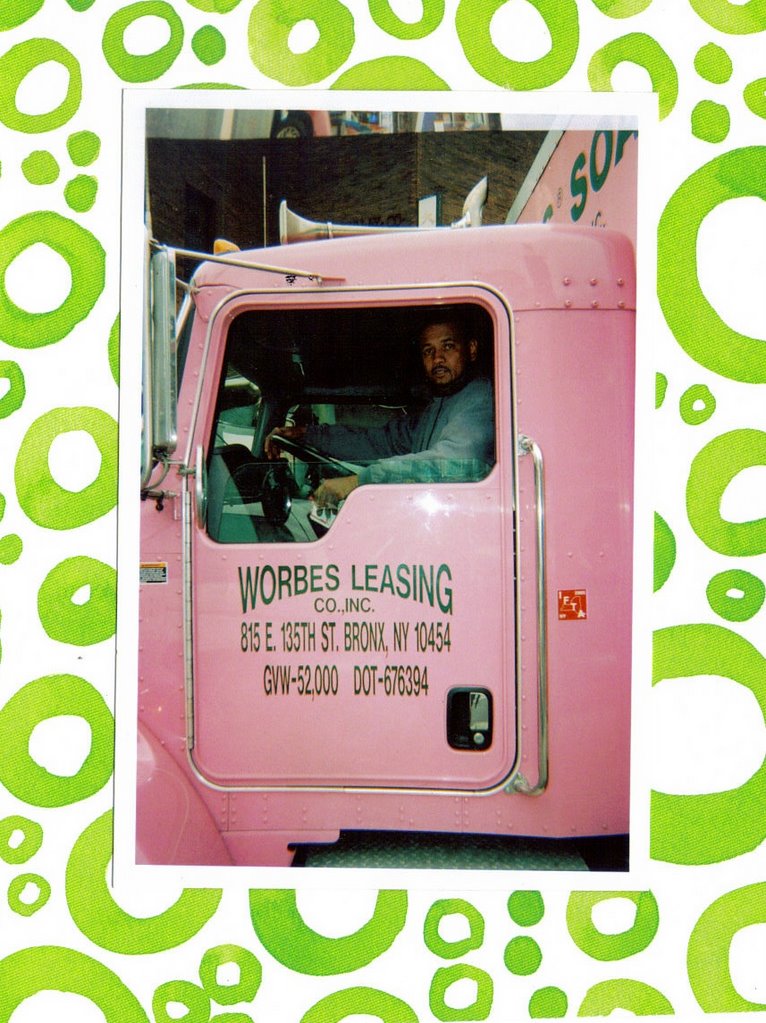
DRIVER OF THE PINK TRUCK

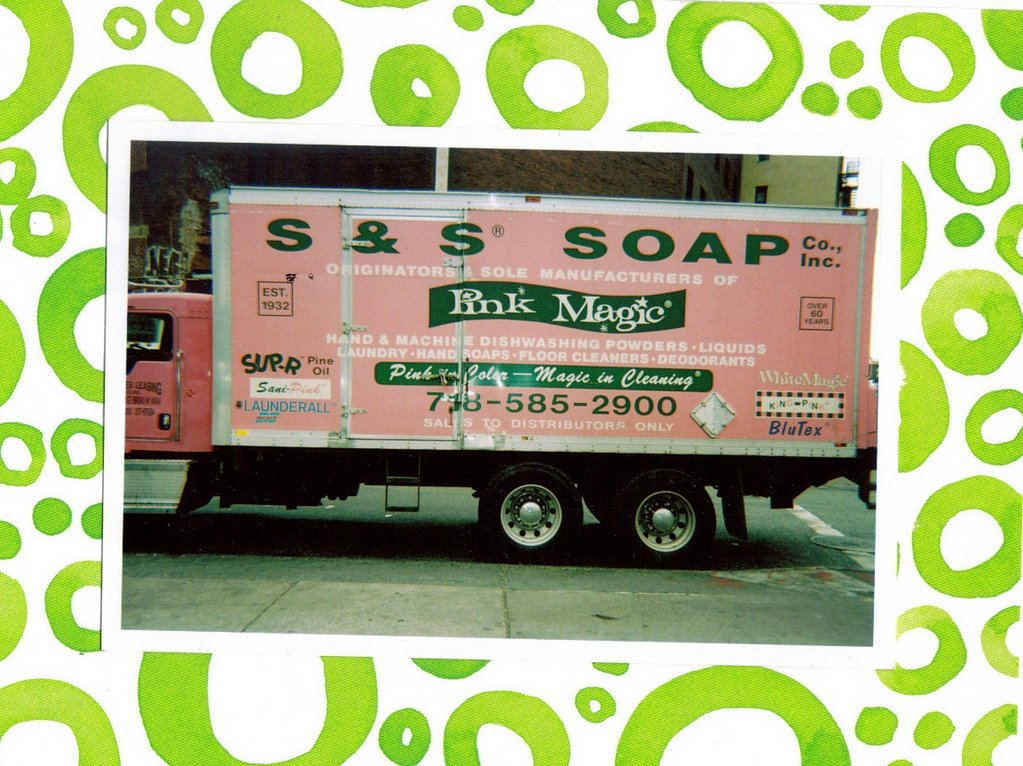
MAGIC PINK SOAP TRUCK

While on the outskirts of Chinatown, I spied this fabulous Pink Magic S & S Soap Company truck. The driver of the truck saw me from across the street and put his hands on his hips, like "What are you doing?" I crossed over, told him how much I loved his truck, and asked him if I could take a picture of him standing in front of it. He said "No" but then decided I could take a picture of him after he got behind the steering wheel.

Monday, January 01, 2007

BOOKS TO KICK OFF THE NEW YEAR

Dare to Dream is the name of the workshop I lead each January. The workshop, which focuses on inspired goal-setting, is for women who take part in a monthly gathering called How to Succeed Without Selling Out. We explore ways we can live our lives in accordance with our own values.

In preparation for the workshop, and to give my own self some inspiration for setting goals for 2007, I read and recommend these three books:

1. This Year I Will...............: How to Finally Change a Habit, Keep a Resolution, or Make a Dream Come True. Written by M.J. Ryan.

2. The Energy Addict: 101 Physical, Mental & Spiritual Ways to Energize Your Life. Written by John Gordon.

3. Comfort Secrets for Busy Women: Finding Your Way When Your Life is Overflowing. Written by Jennifer Louden.

Happy Reading!